Rules Without Rulers by Matthew Wilson
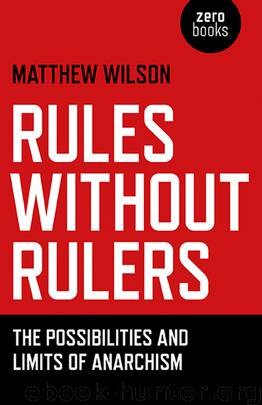
Author:Matthew Wilson [Wilson, Matthew]
Language: eng
Format: epub
ISBN: 978-1-78279-008-2
Publisher: John Hunt Publishing
Published: 2014-08-28T16:00:00+00:00
So the state is not the source of power, but rather made up of various networks of power, which go beyond the state. ‘It is clear’ Newman argues, then, ‘that Foucault’s conception of power is fundamentally different from that of the anarchists’, for whereas ‘anarchists see power as centralised within the state and radiating downwards to the rest of society, Foucault sees power as thoroughly dispersed throughout the social fabric’ (Newman 2001, 79). Now, it is doubtless true that often, power, for anarchists, is presented as being morally bad, and existing exclusively within certain institutions such as the state; it therefore can and should be eliminated, by destroying the state, or the ruling class. So although the classical anarchists are praised by the postanarchists for their analysis of power when it comes to the state, they have not gone far enough in their critique. Unlike other socialists, anarchists are rightly critical of state power, but they have fallen at the second hurdle, so to speak, and have failed to extend this critique beyond the state or other similar institutions. Such an understanding of power has allowed anarchists to see society as somehow separate from power, as a power-free space in which the libertarian can flourish; without power, there can be no domination. Anarchism, then, ‘creates an essential, moral opposition between society and the state, between humanity and power’ (Newman 2001, 47). It is certainly not hard to find evidence of anarchist understandings of power that conform to the critique laid out by postanarchists. According to Dave Morland, ‘power is central to anarchist theory, and anarchists, whether old or new, are united in their belief that it should, wherever possible, be uprooted and eliminated’ (Morland 2004, 23). And David Thoreau Wieck writes that ‘[a]narchists […] propose to reorganise our common life without the crippling destructive principles of power’ (Thoreau Wieck 1970, 91).
For the postanarchists, this understanding of power does not exist in isolation: we need to understand it in relation to a broader network of philosophical assumptions within which these ideas about power lie. As Newman claims,
according to anarchism, human subjectivity emerges in a world of ‘natural laws’ which are essentially rational and ethical, while the state belongs to the ‘artificial’ world of power. Thus man and power belong to separate and opposed worlds. Anarchism therefore has a logical point of departure, uncontaminated by power, from which power can be condemned as unnatural, irrational and immoral (Newman 2001, 5).
Download
This site does not store any files on its server. We only index and link to content provided by other sites. Please contact the content providers to delete copyright contents if any and email us, we'll remove relevant links or contents immediately.
| Anarchism | Communism & Socialism |
| Conservatism & Liberalism | Democracy |
| Fascism | Libertarianism |
| Nationalism | Radicalism |
| Utopian |
The Secret History by Donna Tartt(19097)
The Social Justice Warrior Handbook by Lisa De Pasquale(12193)
Thirteen Reasons Why by Jay Asher(8915)
This Is How You Lose Her by Junot Diaz(6891)
Weapons of Math Destruction by Cathy O'Neil(6283)
Zero to One by Peter Thiel(5805)
Beartown by Fredrik Backman(5763)
The Myth of the Strong Leader by Archie Brown(5511)
The Fire Next Time by James Baldwin(5452)
How Democracies Die by Steven Levitsky & Daniel Ziblatt(5221)
Promise Me, Dad by Joe Biden(5155)
Stone's Rules by Roger Stone(5089)
A Higher Loyalty: Truth, Lies, and Leadership by James Comey(4965)
100 Deadly Skills by Clint Emerson(4929)
Rise and Kill First by Ronen Bergman(4792)
Secrecy World by Jake Bernstein(4755)
The David Icke Guide to the Global Conspiracy (and how to end it) by David Icke(4721)
The Farm by Tom Rob Smith(4516)
The Doomsday Machine by Daniel Ellsberg(4492)
